
In this original UEFN greybox level, I fused two iconic locations from the Lord of the Rings universe—Minas Tirith and Barad-dûr—into one intense battleground. Set in a fantasy world torn between light and darkness, players join a 3v3 capture-the-flag match that demands both teamwork and strategy. The battlefield is split down the middle: the towering spires and gloom of Barad-dûr clash with the radiant majesty of Minas Tirith. Players must shoot, flank, and defend across bridges, spires, and fortresses to control the battlefield and secure the One Ring’s fate. To separate this from the original IP, I am refering to this map as “Dreadspire vs White Crown”
Engine: Unreal Engine For Fortnite
Game Type: 3v3 Capture the Flag
Personal Project
One-person development team
Roles and Responsibilities
Designed map layout using UEFN’s modeling tools
Defined engagement zones, sightlines, choke points, and traversal flow
Built 3v3 Capture the Flag logic using UEFN and Blueprints
Created mirrored bases with distinct visual language for Gondor and Mordor
Integrated key landmarks like the White Tower and Dark Tower for orientation
Placed weapons, health packs, shields, and Chug Jugs to support combat rhythm
Balanced item distribution to promote map exploration and area control
Created a full Level Design Document (LDD) to define gameplay goals and structure
Bubble Diagram of Top Down Layout of Map

Level Design Process
Greyboxing & Blockout
The design began with greyboxing in UEFN using built-in modeling tools to prototype layout ideas rapidly.
Early versions used open node-based zones, but this felt unnatural during playtests—players lacked spatial anchors, and flow felt disconnected.
Pivoted toward a more cohesive blockout approach where structures and forms from Barad-dûr and Minas Tirith organically merged, creating a grounded yet fantastical battleground.
Metrics-Driven Iteration
Created a detailed Level Design Document (LDD) to guide development. Included environment concepts, character/object metrics, layout diagrams, and gameplay flow.
Used player movement data (run speed, jump distance, sightlines) to define traversal paths, combat zones, and item placements.
Designed mirrored sides with different architectural styles (elegant vs. menacing) to support team identity and clarity while maintaining mechanical symmetry.
Mid-Map Redesign & Risk-Reward Spaces
After several test sessions, I reworked the central bridge into a curved cliff area.
This change added verticality and a compelling risk-reward structure—players could climb to the high ridge for powerful gear (Rocket Launcher, Chug Jug) but faced high exposure from all sides.
Gameplay Element Integration
Health, shield potions, and weapons were placed to reinforce pacing and encourage movement through the map.
High-value items were positioned in exposed or difficult-to-reach spots to reward aggressive or skilled players.
Playtesting & Loop Refinement
Conducted multiple rounds of internal and peer playtesting, focusing on flow, engagement hotspots, and pacing.
Made iterative tweaks to item locations, sightlines, and lane structure based on player behavior and feedback.

Parti diagram was developed to get an idea of the shapes and paths that appear when flipping and mirroring one side of the map. The left side would later be replaced with Barad-dur structures but have the same overall shapes.

Flow Diagram of Level

Gameplay Diagram of Level
Problem Solving
The level began with a greybox layout built using UEFN’s modeling tools. My initial approach followed a bubble diagram structure, outlining separate zones for combat, traversal, and objectives. While helpful for early planning, this setup felt disconnected and unnatural during playtests. Movement lacked flow, and areas didn’t blend together in a satisfying way.
To fix this, I transitioned to a more integrated design, where buildings and structures from Minas Tirith and Barad-dûr overlapped and merged. This created a more cohesive map with better flow and visual storytelling, while still preserving mechanical symmetry.
The central area also posed issues—early versions were too flat and unengaging, offering little incentive or risk. I redesigned it into curved cliffs, introducing verticality and risk-reward gameplay. Powerful items like the Rocket Launcher and Chug Jug were placed at the top, making it a high-risk, high-reward zone exposed from all angles.
Finally, the base areas were initially too open, leaving defenders vulnerable and slowing gameplay. I solved this by adding strategic obstacles that block sightlines, offer cover, and create more dynamic traversal paths, enhancing both defense and movement options.
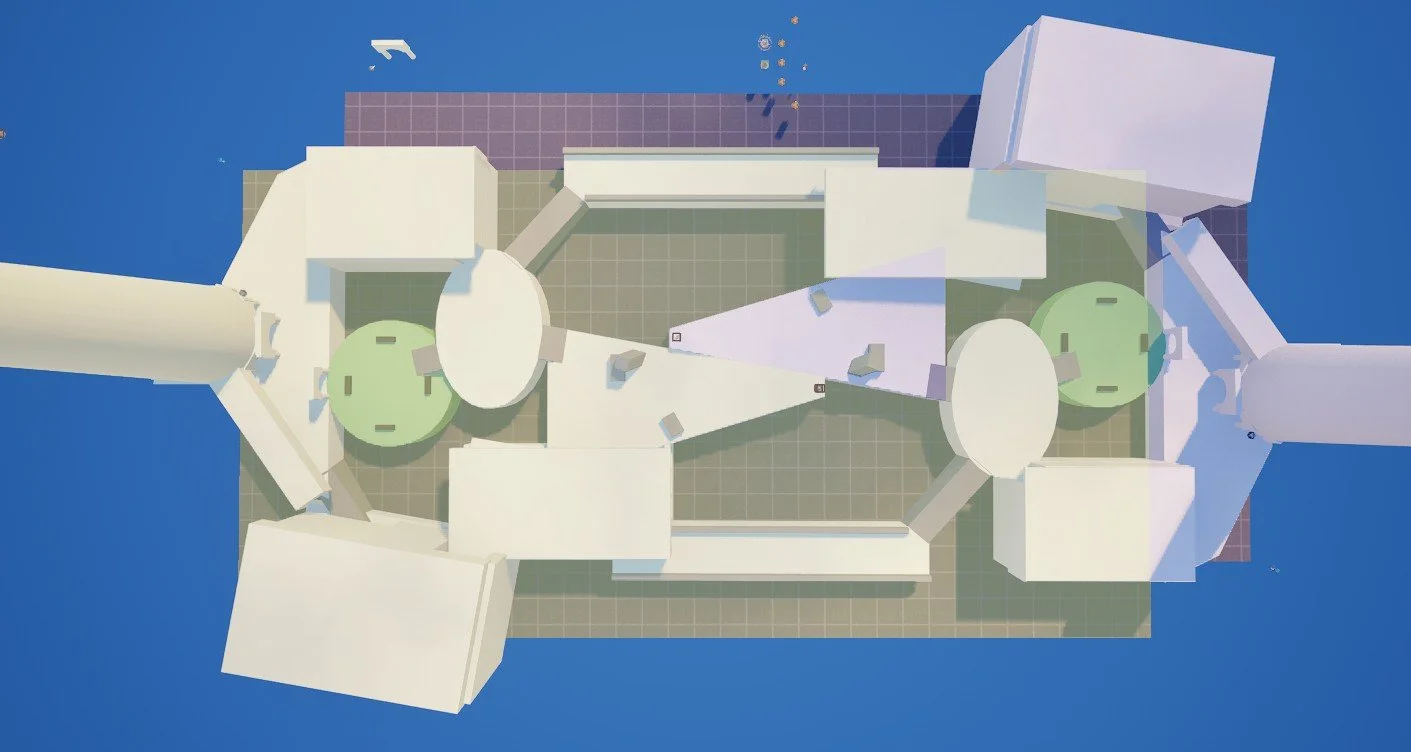
Initial blockout version showing disconnected zones—lacked spatial cohesion and fluid player movement.
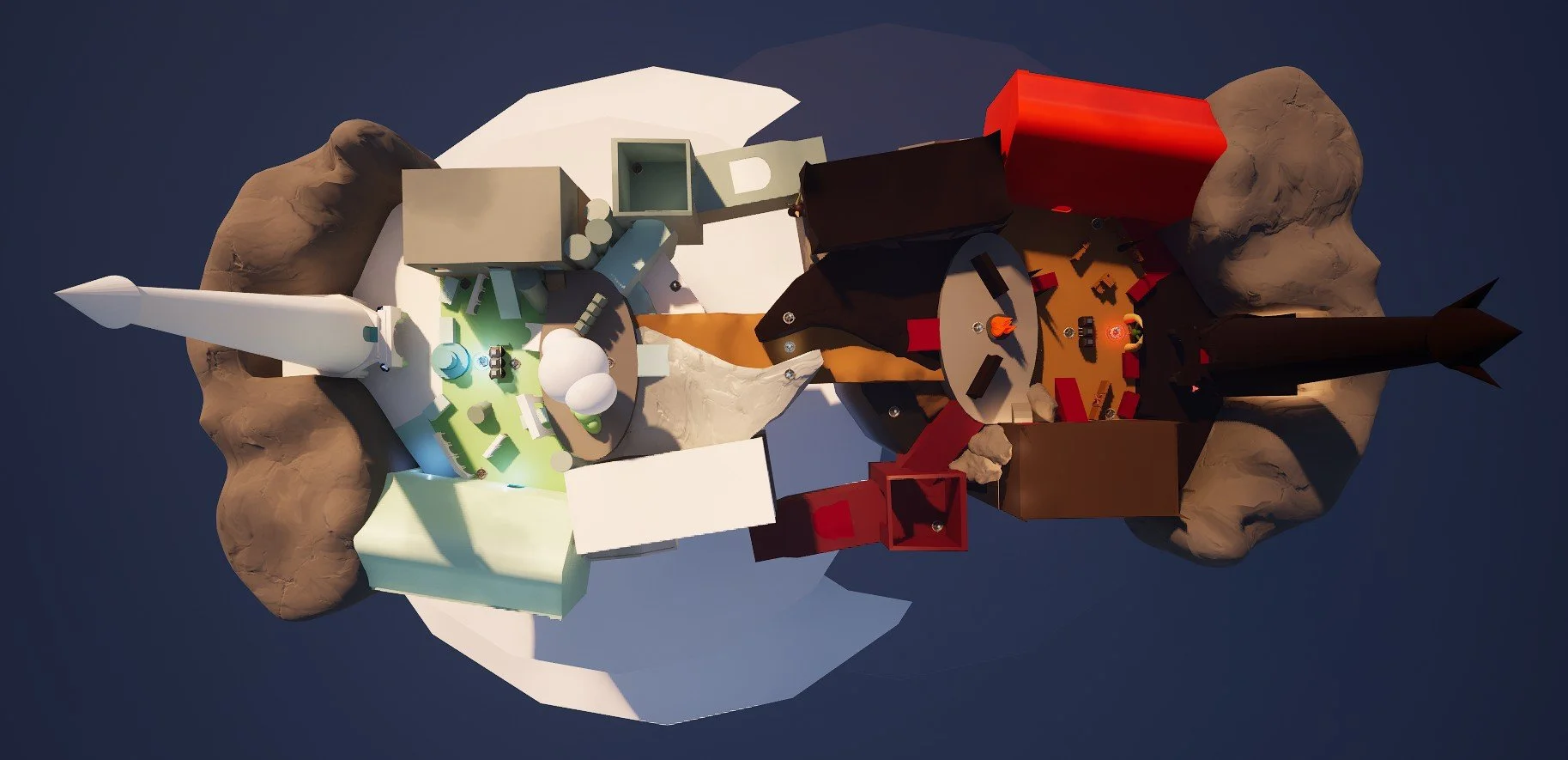
Refined greybox – overlapping architecture and layered design brought the map to life with smoother transitions and natural player paths.
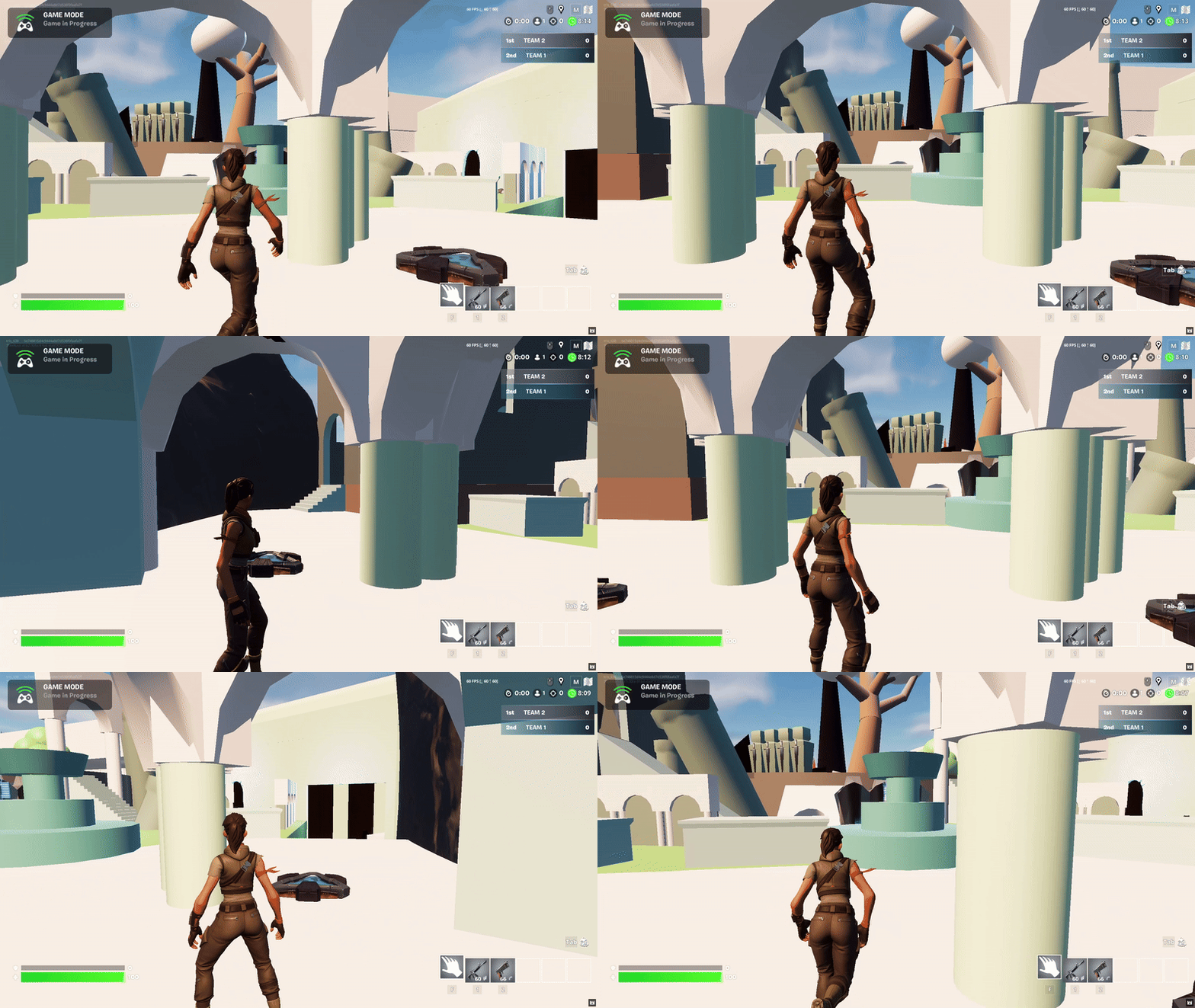
Spawn area overview – showing three distinct path options as players push out from spawn. Spawns are placed behind the flag to encourage defensive positioning, and allow quick flag recovery
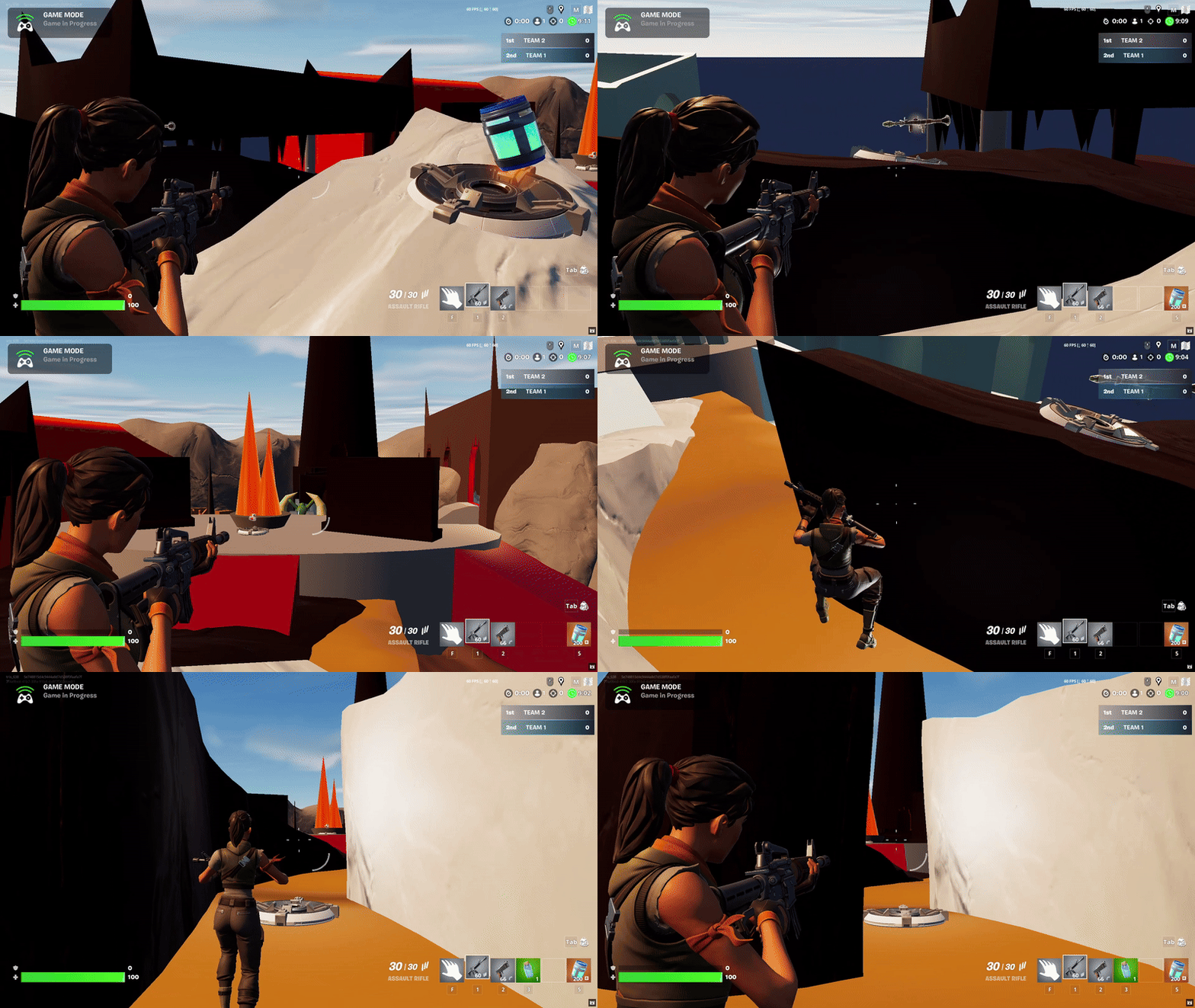
Demonstrating sightline control from mid – players can't safely shoot across the map without exposing themselves, reinforcing the risk-reward design of the central area.
Kit Bash Approach
Key Learnings
Asset Placement Matters
Replacing greybox geometry with final assets isn’t just visual polish—it directly impacts gameplay. Changes in collision, cover, and line of sight meant I had to carefully adjust layouts to maintain balance and flow.Iteration is Essential
With art in place, I discovered that the level’s feel and function changed, requiring multiple rounds of fine-tuning. Gameplay readability, combat pacing, and traversal paths all needed to be re-evaluated post-art pass.Intentional Kitbashing with Constraints
To challenge myself and stay efficient, I limited the build to 24 unique assets for the White Crown base area and another 24 for the central section. This restriction pushed me to reuse base and detail pieces creatively, focusing on form variation and spatial rhythm instead of asset quantity.Establishing a Clear Asset Workflow
I refined a consistent approach using:Base pieces for large structural forms
Detail pieces to create texture, breakup, and grounding
Hero pieces to anchor key visual moments and player direction
To expand my skills and avoid IP restrictions, I reimagined The Battle of Barad-dûr on Minas Tirith into an original version titled Dreadspire vs White Crown. The goal was to elevate the greybox map by replacing all placeholder elements with official Fortnite assets through kitbashing and visual re-theming.
This process focused on the White Crown area, where I replaced greybox geometry with a combination of base, detail, and hero pieces to define the environment. I carefully selected and layered assets to establish visual hierarchy and direct player attention while preserving the layout’s gameplay intent. This transformation allowed me to bring the white, noble architecture of the “good” side to life in a unique style inspired by my own world-building.
By converting an existing greybox into a fully art-passed section using Fortnite’s creative asset library, I honed my ability to translate gameplay structure into visual storytelling.


Before (greybox) and after (kit bash) of flag area in White Crown’s Base